Most people who skip ChatGPT’s voice mode aren’t blocked by anything. The ones who use it go quiet in public, so I prioritised a whisper mode.
36 survey responses. 5 one-to-one interviews. 3 hypotheses tested. 4 solutions ranked by effort and impact.
In three lines
- Fellowship research on one question: how do you increase voice mode adoption in the ChatGPT mobile app in India?
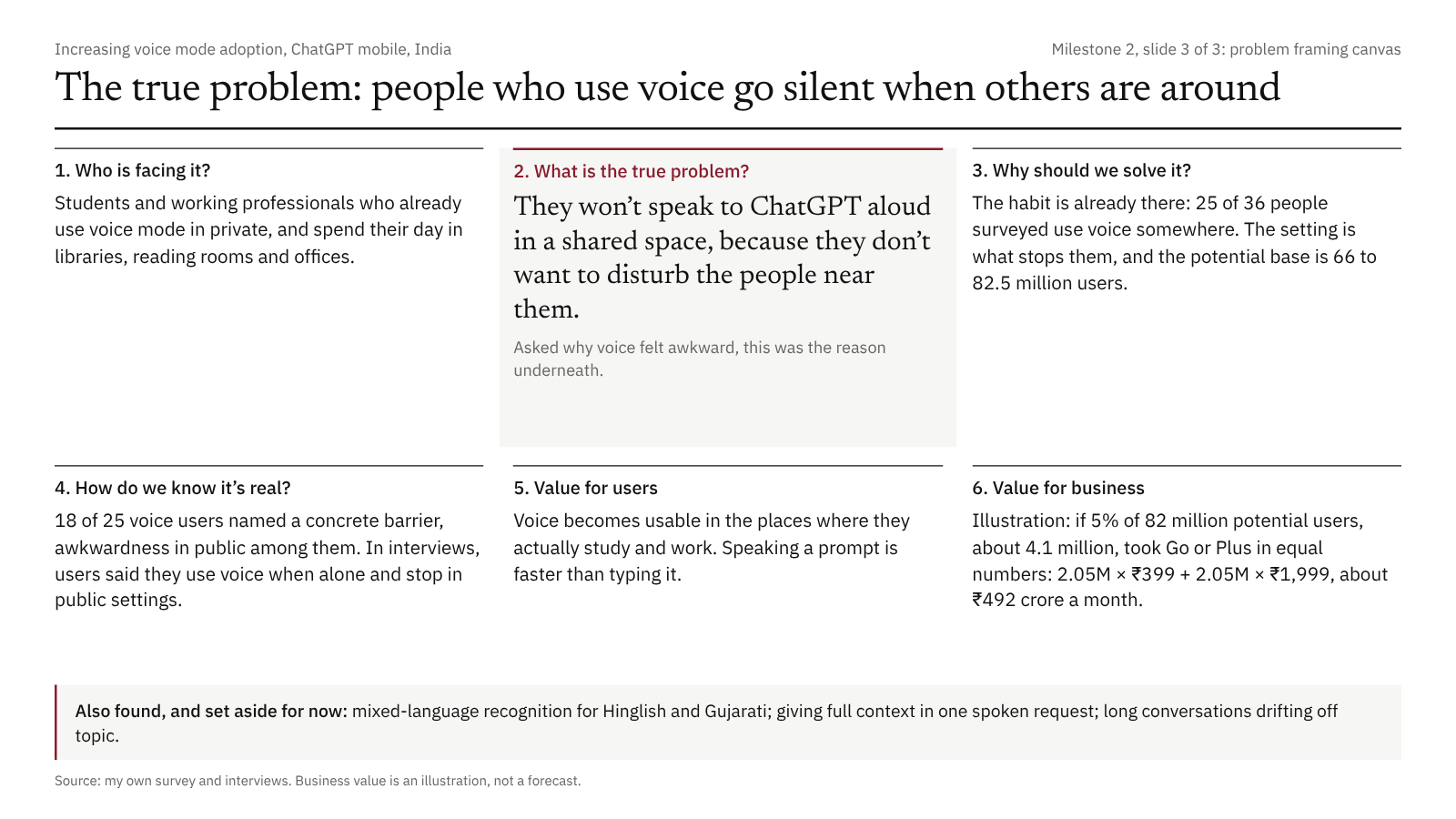
- Of 36 people surveyed, 25 already use voice somewhere. Non-users mostly report no barrier; they prefer typing. Voice users run into mixed-language recognition and the awkwardness of speaking aloud around others.
- I ranked four solutions by effort and impact and prioritised a quiet mode: whisper to ChatGPT in a library or office. I built a clickable prototype of it.
Context
It started with my own habit. I'd been using Wispr Flow, an app that lets me dictate instead of type, and I liked it. That made me curious: if speaking is this easy, why don't more people use ChatGPT's voice mode?
That question became my research problem across three milestones of the NextLeap Product Management Fellowship (Cohort 52): increase voice mode adoption in the ChatGPT mobile app in India.
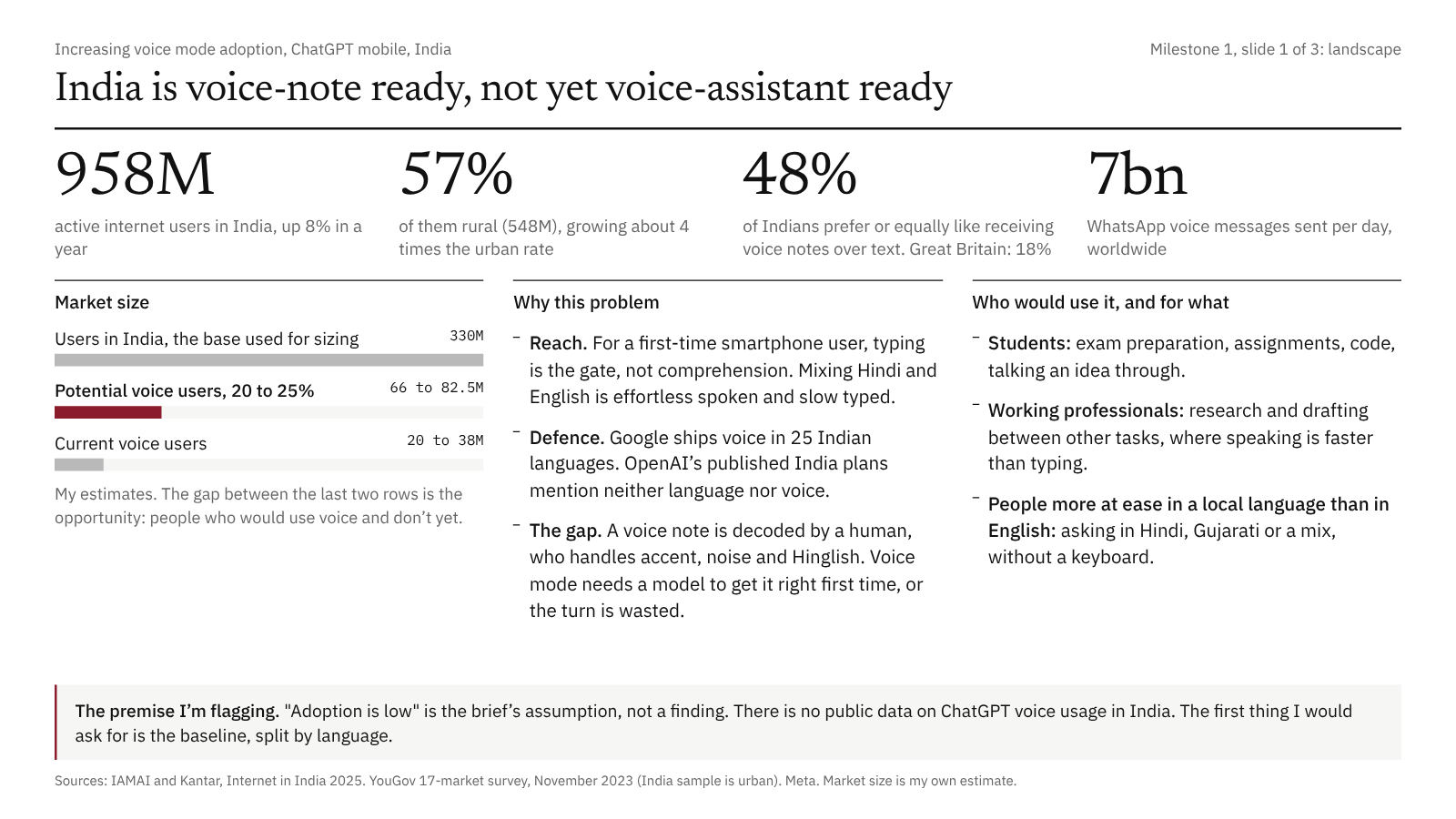
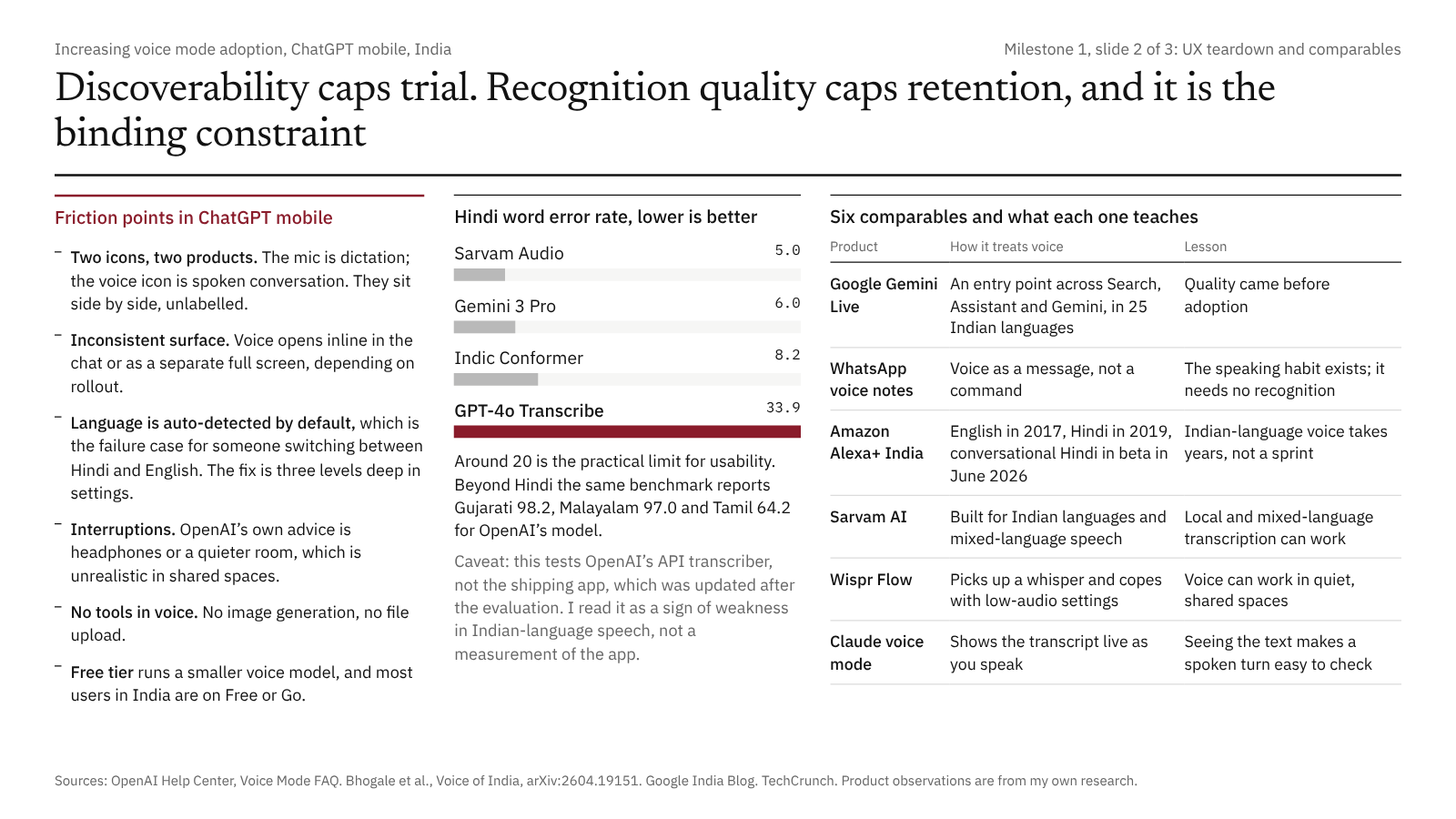
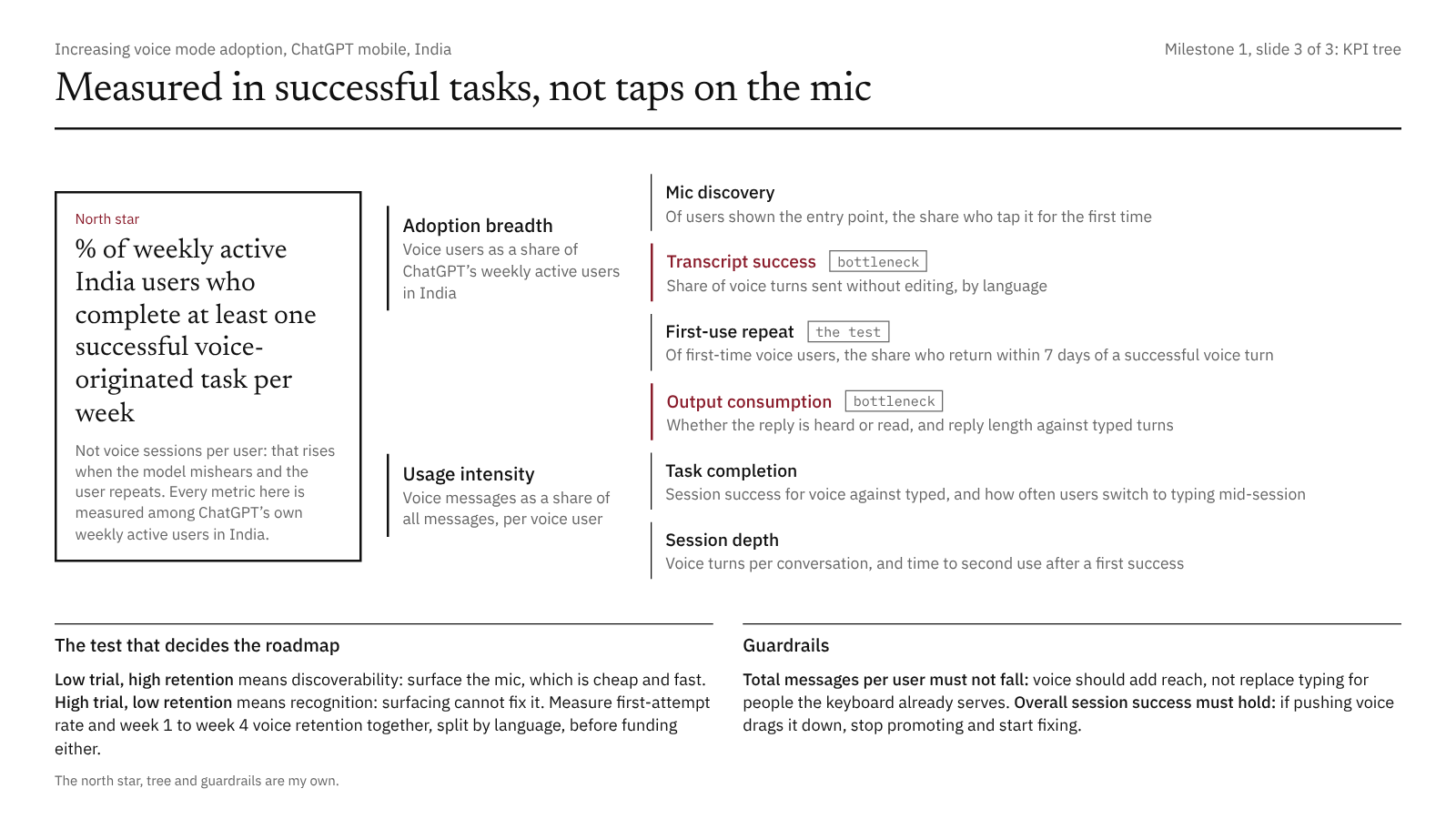
The first milestone was a three-slide deck: the voice landscape in India, a teardown of ChatGPT's voice experience against comparable products, and a KPI tree. The second was user research. The third was a problem definition with prioritised solutions and a prototype.
Problem
India looks ready for voice. People send voice notes constantly. But a voice note is decoded by a human, who has no trouble with an accent or a sentence that switches between Hindi and English. Voice mode needs a model to get it right the first time.
So the question was what actually holds voice mode back: can people not find it, does it not understand them, or is it something else? My first guess was the simplest one: people couldn't find the feature, or didn't know it existed.
One thing I stated up front in the deck: "adoption is low" was the brief's premise, not something I could verify. There is no public data on ChatGPT voice usage in India. The first thing I'd ask for is the baseline, split by language.
What I did
- 1Landscape and teardownSecondary research, 3 slides
- 2Survey36 responses
- 3Interviews5 one-to-one, across 3 user types
- 4Hypotheses3 tested against the evidence
- 5Solutions4 ranked, 1 prototyped
I split users into three groups by behaviour: first-timers who have never used voice mode, aware users who know it exists but rarely use it, and heavy users. I interviewed people from all three.
I wrote three hypotheses before the research and checked each one against what people said.
- Yes8 people
- Occasionally17
- No11
Key decisions and tradeoffs
Who to target. I chose aware users first, then heavy users. They already know the feature, so the gap is a reason to use it, not awareness. First-timers are the larger group but the harder one to move.
What to count as success. My north star from the first milestone:
% of weekly active India users who complete at least one successful voice-originated task per week
Counting voice sessions would go up when the model mishears and the user repeats themselves. A successful task is harder to instrument, but it is the thing that has to rise.
Which solution to build first. I ranked four solutions by effort against impact instead of picking the one that fixes the most-mentioned complaint.
- Quiet mode: whisper input for shared spaces8 to 14 weeks
- Fix the spoken prompt: ask a clarifying question3 to 5 weeks
- Pause and upload documents in voice mode10 to 16 weeks
- Better local and mixed-language recognition9 to 14 months
The tradeoff is real. Better recognition for Hinglish and Gujarati would help more people. But it is 9 to 14 months of data collection, fine-tuning and evaluation. Quiet mode addresses a barrier people named and can ship in a quarter.
What I found
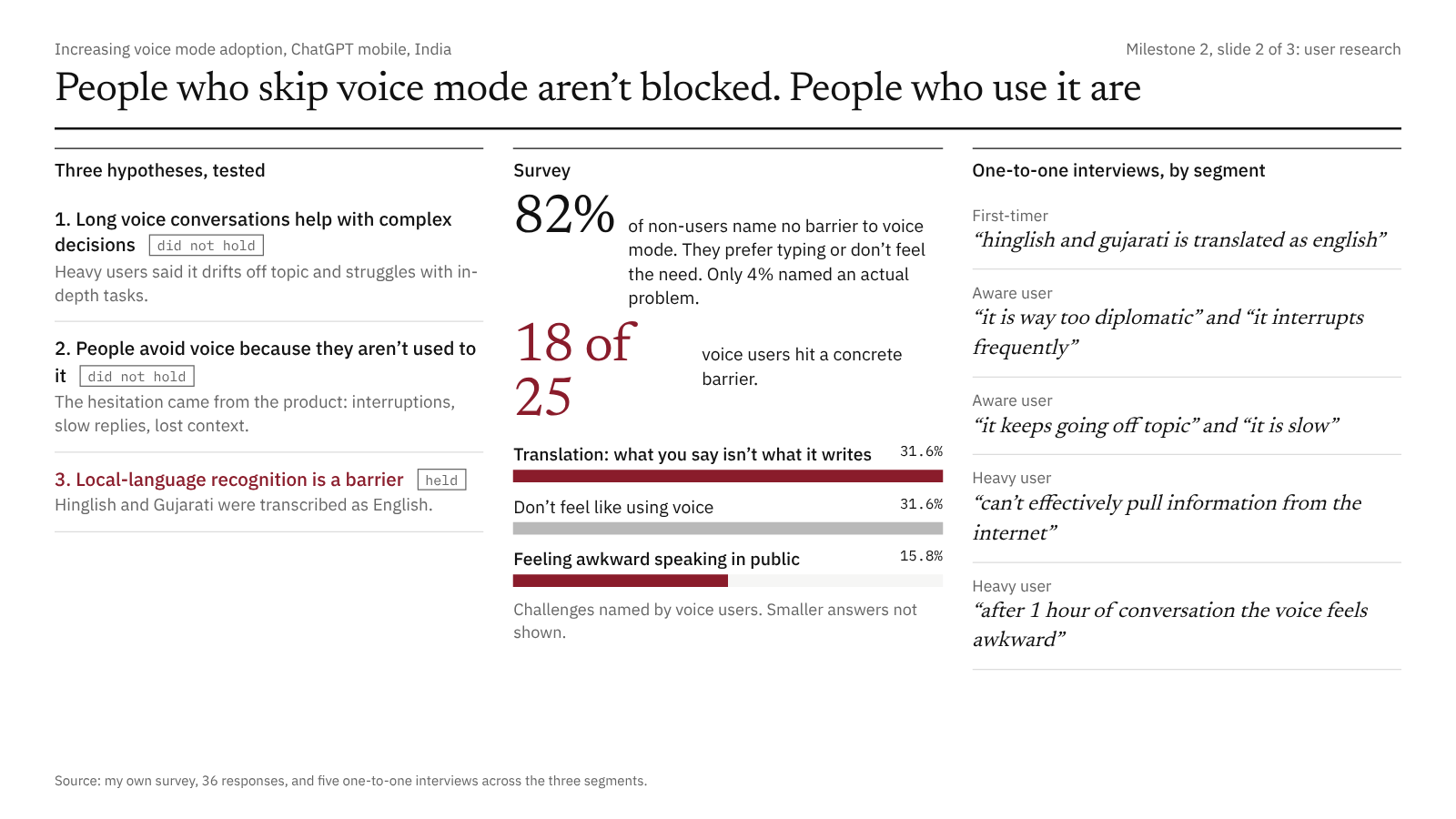
Non-users are not blocked. Asked why they don't use voice mode, 82% of non-users named no barrier. They prefer typing or don't feel the need. Only 4% named an actual problem. That ruled out discoverability as the main issue: making the button more visible would not change a preference.
People who do use voice hit real problems. 18 of the 25 voice users reported a concrete barrier: recognition and translation, or awkwardness.
Mixed-language speech is misheard. One first-time user told me "hinglish and gujarati is translated as english". This was the one hypothesis the research confirmed.
Voice is used in private and dropped in public. Students told me they use voice when alone and stop in libraries, reading rooms and offices. When I asked why, the reason was specific: they did not want to disturb the people around them.
Two of my three hypotheses did not hold. I expected long voice conversations to help with complex decisions. Heavy users said the opposite: it "keeps going off topic", and one said that "after 1 hour of conversation the voice feels awkward". I also expected hesitation to be about habit. It was about the product: "it interrupts frequently".
What it taught me. Adoption isn't only about whether people can find a feature. How they feel using it, and where they are when they'd use it, can matter just as much.
- Long voice conversations help with complex decisions
- People avoid voice only because they aren’t used to it
- Local and mixed-language recognition is a barrier
What I'd do differently
- A wider sample. The 36 respondents were mostly students and working professionals. The local-language persona, someone in a tier 2 or tier 3 town who is less comfortable in English, is the one I reached least.
- Test the prototype with the people who raised the problem. The next step is putting quiet mode in front of the students who said they go silent in libraries, and measuring whether they use it.
- Check background noise early. The main risk I listed for quiet mode is that a whisper is lost in a noisy room. That needs a real test before any estimate of impact.
How it was built
A survey, five one-to-one interviews, hands-on testing of voice mode, and secondary research for the landscape and comparables. The segmentation, hypotheses, synthesis and prioritisation are my own work.
AI use: I used AI for secondary research and to lay out the slides shown on this page. The quiet-mode prototype was built with Lovable, an AI app builder.